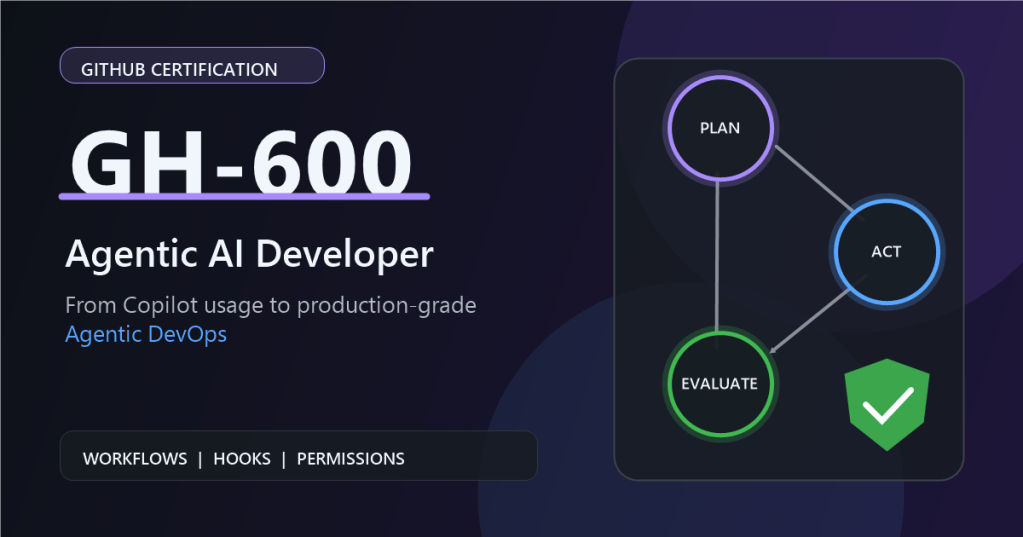
GitHub Copilot is moving quickly. It started for many of us as an assistant that could complete the next line of code or help explain an unfamiliar function. Today, it can plan work, use tools, make changes across a repository, run checks, and open a pull request.
That shift is exactly why the new GH-600 exam caught my attention.
GH-600 is the exam behind the GitHub Certified: Agentic AI Developer certification. The exam is called Developing in Agentic AI Systems, and it focuses on what happens when AI agents become active participants in the software development lifecycle.
This is not just another exam about writing better prompts. It is about operating agents safely inside real development workflows.
Why I think this exam matters
Once you become comfortable with GitHub Copilot, the challenge changes.
The difficult part is no longer getting an AI assistant to generate a method or explain an error. The difficult part is deciding how much work an agent should be allowed to do, which tools it can use, what evidence it must produce, and where a human still needs to make the final decision.
That is where Agentic DevOps becomes important.
To me, Agentic DevOps means applying the same discipline we learned through DevOps to AI agents: small and reviewable changes, automated validation, least privilege, traceability, feedback loops, and clear ownership. An agent may be able to act autonomously, but its work should still move through branches, pull requests, checks, environments, and approvals that the team understands.
This is why I see the GH-600 Microsoft Learn content as a critical next step for anyone maturing their use of GitHub Copilot. The learning journey moves from using Copilot to designing and governing systems of agents.
GitHub also becomes more than the place where the code is stored. It becomes the system of record and the control plane for agent activity. Plans, commits, pull requests, workflow runs, scan results, approvals, and logs give us the evidence needed to understand what an agent did and why.
What GH-600 covers
The official study guide breaks the exam into six domains:
| Domain | Weight |
|---|---|
| Prepare agent architecture and SDLC processes | 15-20% |
| Implement tool use and environment interaction | 20-25% |
| Manage memory, state, and execution | 10-15% |
| Perform evaluation, error analysis, and tuning | 15-20% |
| Orchestrate multi-agent coordination | 15-20% |
| Implement guardrails and accountability | 10-15% |
The percentages are useful, but I would not study these as six isolated topics. They connect to each other.
For example, an agent may need a tool to update a repository. That tool needs a permission. The permission needs a boundary. The action needs a log. The output needs an evaluation. If the evaluation fails, the workflow needs a retry, rollback, or human escalation path.
That full chain is the real skill.
Topics I would focus on
1. GitHub Actions and YAML workflow syntax
I would spend time reading and writing workflow YAML instead of only reviewing slides about it.
Make sure you are comfortable with triggers, jobs, steps, contexts, expressions, dependencies, outputs, artifacts, environments, and secrets. Understand the difference between a workflow triggered by a pull request and one that can perform a deployment. Learn how needs controls job order and how artifacts can carry inspectable evidence from one job to another.
Permissions deserve special attention. A workflow should not receive write access simply because one step might need it.
name: Agent validation

on:
  pull_request:
    branches: [main]

permissions:
  contents: read

jobs:
  agent-review:
    runs-on: ubuntu-latest
    permissions:
      contents: read
      pull-requests: write
    steps:
      - uses: actions/checkout@v4
      - run: npm test
The important part of this example is not memorizing it. It is understanding why the workflow starts with read-only access and only grants the job the additional permission it needs.
The GitHub Actions workflow syntax reference is worth keeping open while you practice.
2. Hooks as enforceable guardrails
Hooks are one of the most interesting topics in this learning path.
Instructions tell an agent what we want it to do. A hook gives us a control point that runs independently of the model's reasoning. That distinction matters. We should not depend on a prompt alone to stop a destructive command or to create an audit record.
I would focus on three patterns:
- Pre-action hooks to inspect or block unsafe tool calls before they run
- Post-action hooks to capture tool usage, results, and other audit evidence
- Error hooks to record failures and start an escalation path
Think about hooks as policy-as-code for agent execution. A pre-tool hook can reject an action outside the approved boundary. A post-tool hook can send evidence to logging or monitoring. An error hook can make sure a failed agent does not silently disappear.
The GitHub Copilot hooks reference is the best place to review the supported lifecycle events and configuration.
3. Agentic permissions and execution boundaries
Agentic permissions go beyond the permissions block in a GitHub Actions file.
You need to think about the complete permission surface:
- Which repository, branch, or environment can the agent access?
- Which GitHub APIs and tools can it call?
- Which MCP servers are approved?
- Can it only read and plan, or can it create a branch and pull request?
- Which secrets are available at runtime?
- Which actions require a reviewer or a protected environment?
- Can it delegate work to another agent?
A useful pattern is to separate planning from execution. A planning or review agent may only need read access. An implementation agent can receive a narrow set of write permissions for a specific repository and branch. A production change should move through a controlled path with required checks and human approval.
Least privilege is not there to make the agent less useful. It limits the blast radius when the agent misunderstands a task, uses the wrong tool, or receives bad context.
4. Tools, MCP, and safe execution
Agents become useful when they can interact with tools and APIs, and MCP is an important part of that story.
For GH-600, I would understand how an MCP server extends an agent, how registries and allow lists control what can be connected, and why a narrow tool set is safer than a wildcard. I would also pay attention to authentication and secret boundaries. An agent should receive a token at runtime only when it needs it; credentials should never be placed in instructions or committed configuration.
Every additional tool increases capability, but it can also increase the blast radius. Adding an MCP server should be reviewed with the same care as adding a high-impact dependency or integration.
5. Memory, evaluation, and multi-agent coordination
These areas are easy to skim, but I would not ignore them.
An agent that works for several minutes or across several sessions needs a reliable way to persist progress and decisions. You should understand the difference between short-term, long-term, and external memory, along with expiration, pruning, reset rules, stale context, and context drift.
Evaluation is also more than asking whether the output "looks good." A useful agent task needs success criteria and evidence. That evidence may include test results, security scans, logs, traces, pull request changes, or workflow artifacts tied to a specific commit.
Multi-agent systems add another level of complexity. Parallel agents can overlap, duplicate work, or produce contradictory changes. Isolation, clear handoffs, durable artifacts, conflict detection, and recovery paths become part of the architecture.
How I would prepare for GH-600
I would use a mix of the official learning content and a small hands-on repository.
- Start with the official GH-600 study guide and use it as the checklist. The skills measured can change, so always return to this page before the exam.
- Complete the Microsoft Learn modules on Foundations of Agentic AI in GitHub, Designing Agent Architecture and SDLC Integration, and Tooling, MCP, and Agent Execution Environments.
- Build one small agent workflow yourself. Have it produce a plan, work on a branch, open a pull request, run required checks, and upload an artifact. Add a hook that blocks one unsafe action and another that records evidence.
- Practice explaining why each control exists. Why is the token read-only? Why is the deployment behind an environment approval? Why does the agent stop after repeated failures? Scenario-based questions become easier when the architecture makes sense.
- Review the certification page for the latest exam details and scheduling information.
The exam page currently lists 120 minutes and six assessed domains. I would avoid relying on unofficial question counts or memorized dumps. This certification is much more valuable if the preparation changes how you design real agent workflows.
In Summary
I am excited about GH-600 because it validates an important change in our industry.
We are moving from AI that suggests code to agents that can participate in delivery. That creates a lot of opportunity, but it also makes DevOps fundamentals even more important. Work still needs to be reviewable. Permissions still need to be scoped. Failures still need recovery paths. Production still needs accountability.
If you are already comfortable using GitHub Copilot, this learning path is a natural next step. It teaches the operational and architectural skills needed to move from personal productivity to safe, production-grade Agentic DevOps.
Good luck with your GH-600 preparation!


Leave a comment